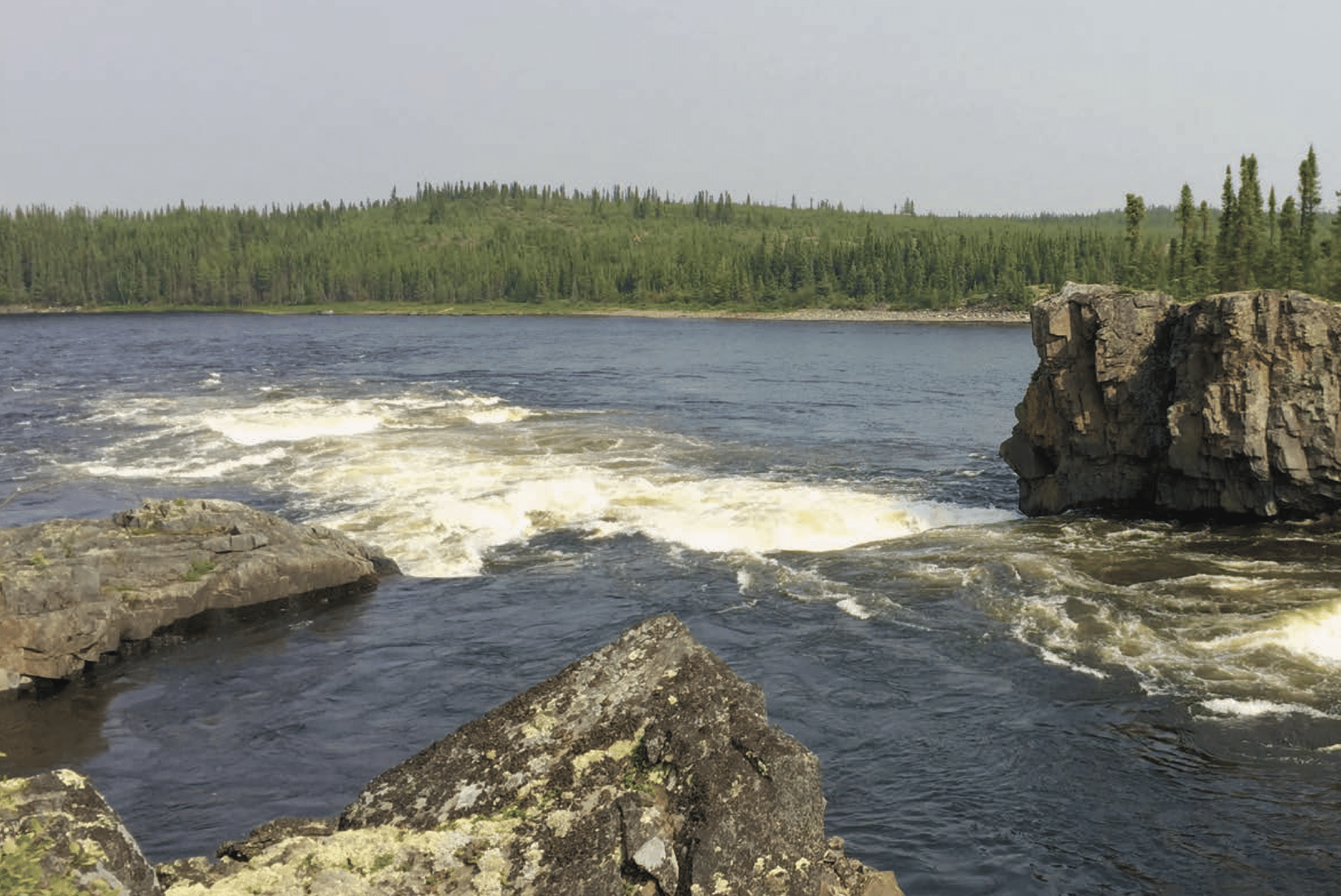

Little Limestone LakeThe biggest and best marl lake in the world!

Comments to the government needed by August 31. Please don’t delay. Do it now!

Little Limestone Lake is the largest and most outstanding marl lake on Earth

Marl is created when calcite, a constituent of limestone, is chemically precipitated from warm water. As the temperature rises, the quantity of marl increases, which changes the colour of the lake. It is common for the lake to transform from a brilliant turquoise in the morning, to a robin's egg blue by mid-afternoon. It’s like a piece of the Caribbean, but its here in Manitoba!

The good news is that our government wants to make Little Limestone Lake a park. The danger is that the boundaries the government is proposing are not large enough to protect the lake and keep it clean and healthy. We have a one-time opportunity to safeguard this unique and special lake forever. The park’s boundaries must be large enough to protect the lake and its water sources and must be agreeable to Mosakahiken First Nation as these are their traditional lands and waters.

Please send your opinion about proper protection for Little Limestone Lake to parksystem@gov.mb.ca


Manitoba Moose and Bats in trouble

The health of wildlife and biodiversity is uneven in Canada’s national and provincial parks, says a new report prepared by the Canadian Parks and Wilderness Society (CPAWS).

In some cases species are at risk of dying out and biodiversity is faltering because habitat has not been adequately protected. In others, good progress has been made to protect wildlife.

The review “How is Wildlife faring in Canada’s Parks?” makes the case that parks are a cornerstone of Canada’s efforts to protect biodiversity – the variety of flora and fauna that make up an ecosystem. However, it notes that bigger, better managed parks, and more of them, are needed if parks are to fulfill their critical role in protecting Canada’s wildlife.

CPAWS prepared its third annual review of parks to mark Canada Parks Day, July 17. The organization focused on biodiversity this year because the United Nations has declared 2010 the International Year of Biodiversity.

“Strengthening our parks system is a key component in protecting out treasured wildlife,” says Ron Thiessen, Executive Director of CPAWS Manitoba.

Large parks protect species

There are 500 species in Canada at risk of extinction and more at-risk species are identified every year.

“Canada has one of the best opportunities in the world to create large parks that protect species that need vast wilderness to survive,” said Thiessen.

CPAWS prescribes a range of measures, including:

  • Creating new parks and expanding existing park boundaries;
  • Maintaining and restoring wildlife movement corridors (so that wildlife have the large ranges they often need);
  • Restricting roads and other damaging developments;
  • Limiting recreational activities; and
  • Practicing good park management focused on healthy ecosystems as a first priority.

Species struggle without adequate parks, good management

Among the good news stories highlighted in the report, where parks help protect vulnerable species, are the Ipswich savannah sparrow of Sable Island, the black dogfish of the Laurentian Channel of the Gulf of St. Lawrence, and the eastern wolf of Algonquin Park.

In Manitoba, moose need help in Nopiming provincial park. A moose hunting ban was recently put in place but a comprehensive plan needs to be designed to ensure their healthy future.

Little brown bats in Manitoba are in trouble and require habitat protection. The proposed Fisher Bay provincial park on the south basin of Lake Winnipeg set to be established this October could be a big part of the solution. At issue are the boundaries for the upcoming park. The concern is that politics may trump sound ecological-based boundaries.

“The International Year of Biodiversity is a good reminder that we need to focus on establishing new parks and properly managing existing parks to ensure our wildlife remains a healthy part of Canada’s landscape,” Thiessen asserted.

-30-

Contact :

Ron Thiessen
Executive Director
CPAWS Manitoba
(204) 794 4971
ron@cpawsmb.org


Present boundaries insufficient

Little Limestone LakeThe present boundaries of the proposed Little Limestone Lake provincial park are inadequate to ensure the lake’s water quality. If polluted waters enter from outside of the protected boundary they will cause irreparable damage to Little Limestone’s delicate eco-system. Protecting Little Limestone’s water sources is required to ensure the lake’s well-being.

“It doesn’t take a genius to know that a 100 meter boundary around the lake is not based on ecological principles,” said Ron Thiessen, Executive Director of the Canadian Parks and Wilderness Society – Manitoba chapter.

“What is also abundantly clear is that the lake just to the south also needs protection because its waters feed Little Limestone,” Thiessen added.

CPAWS has commissioned Dr. Derek Ford, the world’s leading marl lake specialist, to undertake a study this September to help determine what the boundaries should be to properly protect the lake. CPAWS is working with all involved to make certain a large enough area around the lake is permanently protected to maintain the lake’s health as well as traditional activities and sustainable tourism opportunities for the area’s residents.

For more information:

Ron Thiessen
204 794 4971
ron@cpawsmb.org


CPAWS commends Northlands Dene and Sayisi Dene First Nations for their vision and quest to protect their traditional lands and waters in Manitoba’s Boreal Region. The areas proposed for protection are approximately 1.1 million hectares, or about 25 times the size of Winnipeg. This is larger than the country of Jamaica!

The territories of these First Nations are pristine and home to caribou, moose, black bears, wolverines, otters, mink, and migratory birds such as loons, eagles, and plovers. Protection from all industrial developments in these areas will uphold and respect all Treaty Rights of local First Nations people and ensure a healthy future for wildlife.

These lands also store significant amounts of carbon. Keeping carbon in the ground keeps it away from the atmosphere, therefore helping to slow the acceleration of climate change.

For more information on the protected areas proposals please go to:

Please let Premier Selinger know how you feel about permanently protecting the Colvin and Nueltin Lake areas – email now


Kids Camps - Good, No Park Plans - Bad


Sylvia Lake, Feb 2010

The Manitoba government has given approval for Tim Horton’s to construct a children’s camp near Sylvia Lake in Whiteshell provincial park in advance of a up-to-date park management plan. The dusty 27 year old plan for the Whiteshell is no longer relevant as it fails to consider the modern day context. The province had it right in 1983 when they committed to update the Whiteshell plan every ten years. The problem is that they failed to live up to this promise.


CPAWS supports kid’s camps as they are a great way for youth to experience nature and learn how to respect it, but we must first have up-to-date management plans for our parks before further developments take place.

As piecemeal park developments lacking a master vision often lead to disastrous ecological results, CPAWS has long pressed the province to fulfill its commitment to produce park management plans for all our 81 provincial parks. Presently only 3 parks have recent plans and many have no plan at all. You wouldn't consider building a house with a 27 year old plan. You would revise it to incorporate present day knowledge. This is the approach the province needs to take with our treasured provincial parks.


CPAWS' Ron Thiessen (left) delivers a CD containing almost 10,000 letters from concerned international citizens to Hugh McFadyen (right).

Today, copies of almost 10,000 letters from North Americans who support a World Heritage Site on the east side of Lake Winnipeg were delivered to the Manitoba legislature. The letters ask the province to maintain the quest for the prestigious international UNESCO World Heritage Site status for the ecologically and culturally significant region and to hold strong on its decision to not run a major hydro corridor through the area.

Representatives from three leading Manitoba environmental groups made a point of hand delivering copies of the letters to Manitoba Tory leader Hugh McFadyen, the main proponent for an east side hydro corridor routing. A major hydro transmission pathway through the region would jeopardize Manitoba’s chance of UNESCO granting a world heritage site.

The competition to achieve World Heritage Site designation is challenging as many apply, few are chosen. Manitoba needs to make its application the best it can be. Contrary to assertions that a major hydro route would not harm the world heritage site bid, in the past year UNESCO removed WHS status from a site in Germany because of inappropriate developments and warned others that status may be lost if proposed developments are given the go-ahead.

People across North America are recognizing the ecological and cultural values of the largest intact boreal forest on earth, and are standing up to ensure conservation opportunities aren’t lost to unchecked industrial developments. The Heart of the Boreal is one of the greatest storehouses of carbon, and greatest sources of fresh water on the planet. First Nations communities in the Heart of the Boreal are putting conservation and communities first by requesting protection for the lands and waters of the East Side.

Prior to the Manitoba government’s 2007 announcement that they would not allow a hydro line to be built through the East Side, 13,000 letters from Manitobans were sent to the province supporting conservation and the World heritage Site bid in the Heart of Boreal.

Today’s letters were delivered on a CD, together with blank sheets of paper visually representing the number of letters. Mr. McFadyen was encouraged to use the 100% post-consumer, recycled, non-chlorine-bleached paper in his office.

The Heart of the Boreal initiative is comprised of the Boreal Forest Network, the Canadian Parks and Wilderness Society, and the Wilderness Committee. The U.S. based Natural Resources Defense Council is working with the groups to assist in educating North Americans about the conservation opportunity on the east side of Lake Winnipeg.

Contact:

Ron Thiessen, Canadian Parks and Wilderness Society, 204–794–4971, ron@cpawsmb.org
Eric Reder, the Wilderness Committee, 204–997-8584, eric@wildernesscommittee.mb.ca
Susanne McCrea, The Boreal Forest Network 204-297-0321, borealaction@gmail.com
Susan Casey-Lefkowitz, The Natural Resources Defense Council, 202-289-2366, sclefkowitz@nrdc.org

For photos, video and link to action, see Website: www.heartoftheboreal.ca
-30-


Following two years of negotiations, CPAWS and sister conservation organisations have reached an historic agreement with the Forest Products Association of Canada (FPAC). CPAWS played a leadership role in achieving this agreement.

The Canadian Boreal Forest Agreement... applies to over 70 million hectares of Canada's Boreal forest licensed to FPAC member companies across the country.

  • commits these companies to world-leading sustainable forest management practices and conservation planning.
  • focuses on protecting the Boreal woodland caribou's critical habitat.
  • is signed by CPAWS and eight other conservation organizations, and 21 forestry companies represented by FPAC
  • In Manitoba, almost 10 million hectares, or an area over 3 times the size of Vancouver Island, will be off-limits to new logging while conservation plans are being developed

This agreement will provide a strong base for advancing collaboration on Boreal conservation projects between CPAWS chapters and FPAC member companies over the next decade.

FPAC and its members have responded positively to CPAWS' campaign to protect Boreal woodland caribou. We look forward to working with industry, governments, indigenous peoples and local communities to permanently protect more of Canada's Boreal forest in coming years.