
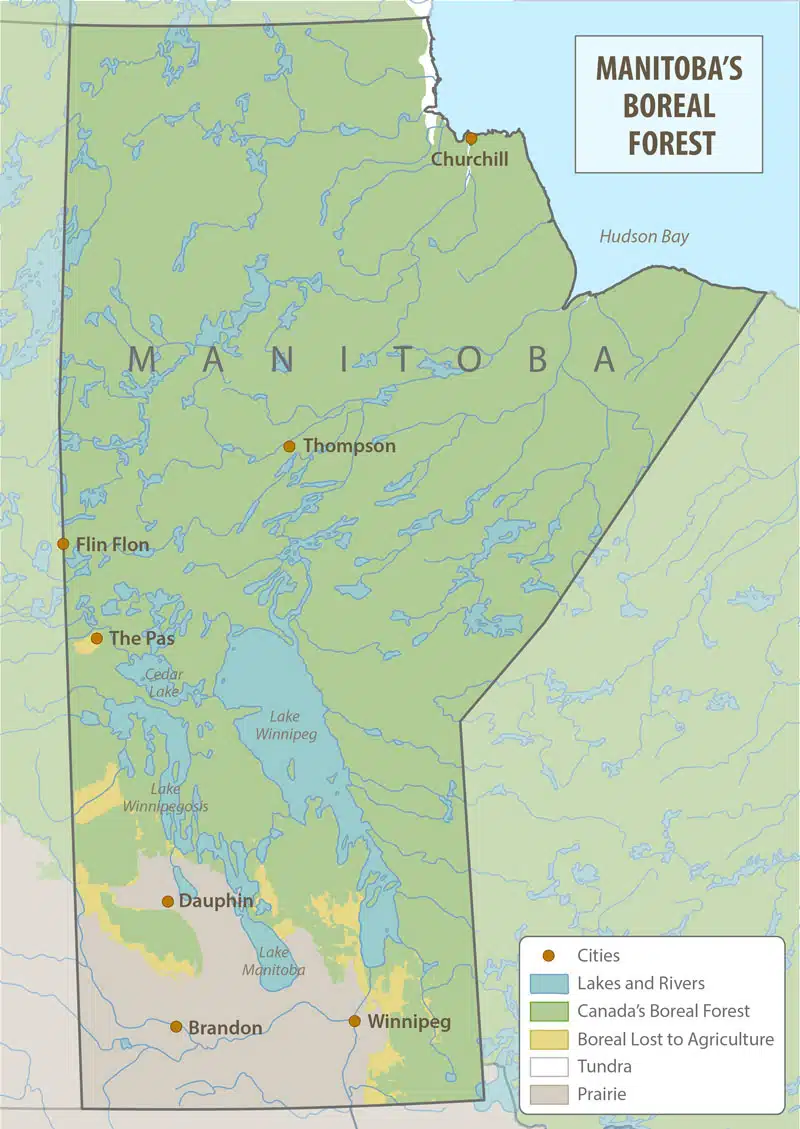
Boreal Forest

The Canadian Boreal Forest

The land that gives life

Eastside says no to Hydro, yes to roads and eco-tourism
Martin Zeilig
July 3, 2010

AS she surveys the bountiful boreal forest spreading out in all directions from the boulder strewn shore of Weaver Lake, Sophia Rebliauskas reflects on what this land on the east side of Lake Winnipeg means to her people.

"It is our home," says the resident of Poplar River First Nation, who is the community coordinator for Pimachiowin Aki Corporation (PAC) World Heritage Project.

Weaver Lake, which is located about 280 kilometres northeast of Winnipeg and is only accessible by float-plane or boat, has been home to a First Nations healing camp for the past decade.

I was one of a group of five media representatives invited to spend two days recently at the healing camp meeting with participants and sharing in the opening session of the gathering. The healing camp, which was attended by Ojibwa elders from four Manitoba First Nations, coincided with the first national hearing in Winnipeg of the Truth and Reconciliation Commission on residential schools.

We were also taken on a boat tour of this proposed UNESCO World Heritage Site -- an area that has been touted as a better route for Manitoba Hydro's new Bipole III transmission line from northern generating stations to Winnipeg than the longer and more expensive west side route.

In 2004, the Government of Canada added the Pimachiowin Aki area to its list of "tentative World Heritage Sites," signaling the launch of the World Heritage Project, explained Gord Jones, project manager since 2007.

"I am opposed to an east side hydro line because this is intact boreal forest," said Rebliauskas, the mother of three adult children and one grandchild.

"But, an all weather road is a necessity. This year, the winter road melted quickly. We were driving through ruts."

In fact, she admitted that meetings are now being held between the First Nations communities and government representatives for an east side road planning authority.

Nevertheless, any sort of development would disrupt the ecosystem and life on the land, added the gregarious Rebliauskas, who mentions that Pimachiowin Aki is Objiwe for "the land that gives life."

Besides Poplar River, the other members of PAC include Pikangikum First Nation, Pauingassi First Nation, Little Grand Rapids First Nation, Bloodvein First Nation, Manitoba Conservation and the Ontario Ministry of Natural Resources.

The project area consists of some 40,000 square kilometres and includes Manitoba's Atikaki Provincial Park and the adjoining Woodland Caribou Provincial Park in Ontario -- both are prime canoeing and wildlife areas.

During our boat trip on a mostly sun-splashed afternoon, we stopped at a site containing the faded outlines of ancient rock paintings.

Indigenous people have been here for 5,000 to 6,000 years -- since the last glaciers receded, remarked Jones, as we stood atop a rocky ridge gazing at Thunder Mountain on the distant horizon with Weaver Lake below us and the thick forest extending as far as the eye could see.

"The boreal forest is recognized as a valuable eco-system," he said.

"It's recognized as the lungs of the Earth. It sequesters carbon and is a good place to study climate change. It also sustains indigenous people who have been part of this region for thousands of years. Indigenous people have knowledge and belief systems important for everyone."

There are 890 World Heritage Sites located in 148 countries, according to information from UNESCO. Of these, 689 are cultural, 176 are natural and 25 are mixed properties. Such spectacular sites as the Grand Canyon, the Canadian Rocky Mountain Parks (one of 13 World Heritage Sites in Canada), the pyramids of Egypt, and Uluru (Ayers Rock) in Australia have all achieved the designation.

Both Jones and Rebliauskas believe that having the region declared an official World Heritage Site would help create income for the First Nations communities by stimulating eco-tourism.

"When a place gets recognized as a World Heritage Site people from all over the world will want to visit the land," said Jones, who noted that the formal nomination for a WHS will take place in February 2012 with a further 18 months for review and approval by UNESCO.

Already, some First Nations lodge owners in eastern Manitoba are planning on how they can help create jobs through eco-tourism, observed Rebliauskas, who, along with her husband, runs a lodge in Poplar River.

"For our First Nations, the forests are our heritage," stressed one elder to me back at the healing camp as I nodded my head in agreement.

Indeed, the land that gives life must be protected for all of us.

Martin Zeilig is a Winnipeg writer.

Republished from the Winnipeg Free Press print edition July 3, 2010 h6

AS she surveys the bountiful boreal forest spreading out in all directions from the boulder strewn shore of Weaver Lake, Sophia Rebliauskas reflects on what this land on the east side of Lake Winnipeg means to her people.

"It is our home," says the resident of Poplar River First Nation, who is the community coordinator for Pimachiowin Aki Corporation (PAC) World Heritage Project.

Weaver Lake, which is located about 280 kilometres northeast of Winnipeg and is only accessible by float-plane or boat, has been home to a First Nations healing camp for the past decade.


Group works towards getting world heritage site designation for boreal forest area

Rachel Lagacé
June 17, 2010

A group of First Nations from Manitoba and Ontario are working together to have their traditional lands deemed a UNESCO World Heritage site.

"There are fewer and fewer places in the world that have been left undeveloped, unchanged by human activity" said Gord Jones, with the Pimachiowin Aki World Heritage group.

The group involves the Poplar River, Little Grand Rapids and Pauingassi First Nations in Manitoba and the Pikangikum First Nation in Ontario, with support from Ontario and Manitoba's governments.

The UNESCO designation would protect 40,000 square kilometres of forest, rivers and traditional territories.

"Our people have lived here for thousands of years and without that land they wouldn't have been able to survive," said Sophia Rabliausku, who wants the land protected under the UNESCO designation.

Hidehiro Otake, a freelance photographer from Japan, travelled to the area to capture images of the wild wolf because the animal is extinct in his homeland.

"It's very important so this place should be protected somehow," said Otake.

The Pimachiowin Aki World Heritage group plans to submit all its nomination material to UNESCO's world heritage committee by February 2012.

- with a report from CTV's Rachel Lagacé

A group of First Nations from Manitoba and Ontario are working together to have their traditional lands deemed a UNESCO World Heritage site.

"There are fewer and fewer places in the world that have been left undeveloped, unchanged by human activity" said Gord Jones, with the Pimachiowin Aki World Heritage group.

The group involves the Poplar River, Little Grand Rapids and Pauingassi First Nations in Manitoba and the Pikangikum First Nation in Ontario, with support from Ontario and Manitoba's governments.


International Plea to Protect the Heart of the Boreal – East side of Lake Winnipeg McFadyen gets a surprise delivery

May 25, 2010

CPAWS' Ron Thiessen (left) delivers a CD containing almost 10,000 letters from concerned international citizens to Hugh McFadyen (right).

Today, copies of almost 10,000 letters from North Americans who support a World Heritage Site on the east side of Lake Winnipeg were delivered to the Manitoba legislature. The letters ask the province to maintain the quest for the prestigious international UNESCO World Heritage Site status for the ecologically and culturally significant region and to hold strong on its decision to not run a major hydro corridor through the area.

Representatives from three leading Manitoba environmental groups made a point of hand delivering copies of the letters to Manitoba Tory leader Hugh McFadyen, the main proponent for an east side hydro corridor routing. A major hydro transmission pathway through the region would jeopardize Manitoba’s chance of UNESCO granting a world heritage site.

The competition to achieve World Heritage Site designation is challenging as many apply, few are chosen. Manitoba needs to make its application the best it can be. Contrary to assertions that a major hydro route would not harm the world heritage site bid, in the past year UNESCO removed WHS status from a site in Germany because of inappropriate developments and warned others that status may be lost if proposed developments are given the go-ahead.

People across North America are recognizing the ecological and cultural values of the largest intact boreal forest on earth, and are standing up to ensure conservation opportunities aren’t lost to unchecked industrial developments. The Heart of the Boreal is one of the greatest storehouses of carbon, and greatest sources of fresh water on the planet. First Nations communities in the Heart of the Boreal are putting conservation and communities first by requesting protection for the lands and waters of the East Side.

Prior to the Manitoba government’s 2007 announcement that they would not allow a hydro line to be built through the East Side, 13,000 letters from Manitobans were sent to the province supporting conservation and the World heritage Site bid in the Heart of Boreal.

Today’s letters were delivered on a CD, together with blank sheets of paper visually representing the number of letters. Mr. McFadyen was encouraged to use the 100% post-consumer, recycled, non-chlorine-bleached paper in his office.

The Heart of the Boreal initiative is comprised of the Boreal Forest Network, the Canadian Parks and Wilderness Society, and the Wilderness Committee. The U.S. based Natural Resources Defense Council is working with the groups to assist in educating North Americans about the conservation opportunity on the east side of Lake Winnipeg.

Contact:

Ron Thiessen, Canadian Parks and Wilderness Society, 204–794–4971, ron@cpawsmb.org
Eric Reder, the Wilderness Committee, 204–997-8584, eric@wildernesscommittee.mb.ca
Susanne McCrea, The Boreal Forest Network 204-297-0321, borealaction@gmail.com
Susan Casey-Lefkowitz, The Natural Resources Defense Council, 202-289-2366, sclefkowitz@nrdc.org

For photos, video and link to action, see Website: www.heartoftheboreal.ca
-30-


Tories get 10,000 letters against BiPole on east side

PAUL TURENNE
May 26, 2010

An environmental coalition surprised Tory Leader Hugh McFadyen Tuesday with 10,000 letters urging the province to stand firm against a major transmission line down the east side of Lake Winnipeg.

McFadyen and his party have long opposed the government's stance, arguing BiPole III should be built down the east side, rather than west of lakes Winnipegosis and Manitoba, the route the government chose in 2007.

Ron Thiessen, Manitoba director of the Canadian Parks and Wilderness Society, had a brief discussion with McFadyen as he presented him with a CD version of the letters and one blank piece of paper symbolizing them.

"Debate and perspective on these issues is good," McFadyen said, noting that his party has "a respectful disagreement" with CPAWS and its partners in the initiative, including The Wilderness Committee, the Boreal Forest Network and the U.S.-based Natural Resources Defense Council.

The groups argue running BiPole III down the east side would jeopardize a bid to have the area designated a UNESCO World Heritage site, as well as compromising the ecological and cultural benefits of keeping the forest intact.

A spokeswoman for the Tories said the vast majority of the signatories to the letters are American, with only a handful coming from Manitoba.

An environmental coalition surprised Tory Leader Hugh McFadyen Tuesday with 10,000 letters urging the province to stand firm against a major transmission line down the east side of Lake Winnipeg.

McFadyen and his party have long opposed the government's stance, arguing BiPole III should be built down the east side, rather than west of lakes Winnipegosis and Manitoba, the route the government chose in 2007.


Tory Leader Hugh McFadyen Gets A Message - No East Side BiPole

May 25, 2010

Today, Manitoba Tory leader Hugh McFadyen got a message from nearly 10,000 international supporters of the proposed UNESCO World Heritage Site, who agree with the Province of  Manitoba that the east side of Lake Winnipeg is no place for Manitoba Hydro’s next major transmission corridor – BiPole 3.

The Manitoba leaders of the Boreal Forest Network, the Wilderness Committee and the Canadian Parks and Wilderness Society personally delivered the letters to McFadyen, the main proponent for an east-side hydro-corridor routing.

The groups made it clear that a major hydro transmission pathway through the region would jeopardize Manitoba’s chance of UNESCO granting the area World Heritage Site status.
 
People across North America are recognizing the ecological and cultural values of the largest intact boreal forest on earth, and are standing up to ensure conservation opportunities aren’t lost to unchecked industrial developments. The Heart of the Boreal is one of the greatest storehouses of carbon, and greatest sources of fresh water on the planet. First Nations communities in the Heart of the Boreal are putting conservation and communities first by insisting on protection for the lands and waters of the east-side boreal area.

The letters were delivered on a CD together with blank sheets of paper visually representing the number of letters. Mr. McFadyen was encouraged to use the 100% post-consumer-recycled, non-chlorine-bleached paper in his office.
 
The U.S.-based Natural Resources Defense Council initiated the action alert with the support of the Canadian groups, and is working to assist in educating North Americans about the conservation opportunity on the east side of Lake Winnipeg.

-30-

Today, Manitoba Tory leader Hugh McFadyen got a message from nearly 10,000 international supporters of the proposed UNESCO World Heritage Site, who agree with the Province of  Manitoba that the east side of Lake Winnipeg is no place for Manitoba Hydro’s next major transmission corridor – BiPole 3.

The Manitoba leaders of the Boreal Forest Network, the Wilderness Committee and the Canadian Parks and Wilderness Society personally delivered the letters to McFadyen, the main proponent for an east-side hydro-corridor routing.


Agreement halts new logging

Categories:
Historic pact protects 29-M hectares of forest
Larry Kusch
May 19, 2010

Environmentalists and Canada's pulp and paper companies -- including three operating in Manitoba -- have decided it's better to co-operate than fight.

On Tuesday, an historic agreement was announced that will halt new logging on 29 million hectares of forest for three years while plans are developed to protect endangered caribou and other species.

How it affects Manitoba

Manitoba has a total of 15.9 million hectares of commercial forest within its boreal zone.

Three forestry companies who operate here are signatories to the agreement: Tembec, Tolko Industries and Louisiana-Pacific Canada.

About 13.3 million hectares of the 72 million hectares of total public forest lands licenced to the Forest Products Association of Canada are located in Manitoba.

The Canadian Boreal Forest Agreement commits to no harvesting or road-building on about 10 million hectares (25 million acres) in Manitoba for three years while action plans are put in place to protect at-risk species such as the woodland caribou.

Tolko's management area in Manitoba alone is nine million hectares, of which 4.3 million hectares are considered productive forest lands.

At the same time, Greenpeace and other environmental watchdogs are suspending "do not buy" campaigns targeting Canadian forestry companies. The groups had previously lobbied paper suppliers Staples and Office Depot and fashion house Victoria's Secret against buying paper from Canada.

"The essence of the agreement is breaking the adversarial win-lose model and learning how to live in a problem-solving way," said Avrim Lazar, president of the 21-member Forest Products Association of Canada.

A local leader of one of the nine environmental groups that signed on to the deal called it "the largest conservation agreement" ever.

"It's a fabulous opportunity for industry and environmental organizations to work together towards common goals," said Ron Thiessen, executive director of the Manitoba division of the Canadian Parks and Wilderness Society (CPAWS). "We both have a vested interest in the outcome."

He said CPAWS will be sitting down with Manitoba's three large forestry companies -- Tolko Industries, Tembec and Louisiana-Pacific Canada -- to work out caribou management plans along with representatives of First Nations and the federal and provincial governments.

The agreement announced Tuesday will give Canadian pulp and paper companies "an edge in the marketplace as more buyers are looking toward buying more environmentally friendly or responsible products," Thiessen said.

If talks fleshing out the deal are fruitful, environmental groups will become allies of the forest companies, who are attempting to rebound from an economic downturn.

Lazar said the agreement could eventually help companies gain quicker access to the trees they need to stay in business. "We've got to put aside some land we were hoping to log. They (the environmental groups) will go with us to government saying, 'C'mon, we've got to find a way of letting these guys stay in business and protect the environment.' "

A spokesman for Tembec, which has idled its Pine Falls paper mill and put it up for sale, could not be reached on Tuesday. An official with Louisiana-Pacific referred a reporter to the forestry products association for comment.

Doug Hunt, woodlands manager for Tolko Industries in Manitoba, which operates a kraft paper mill at The Pas, said the agreement won't have a significant impact on its Manitoba operations.

He said Tolko has worked closely with the province on "caribou planning" since the early 1990s. "When we (go) to an area that the government has considered significant with respect to caribou habitat, we sit down and work out a detailed plan of where we can cut and where we can't cut. This process takes quite a while to work out," he said, adding that now the process will be more transparent.

The new deal wasn't uniformly praised by environmental groups. The Wilderness Committee said the 29 million hectares of protected forest cited by proponents is misleading. It comprises the area surrounding logging cut blocks that was not going to be logged anyway, the group said in a news release.

However, Eric Reder, a Manitoba spokesman for the Wilderness Committee, welcomed the new "working relationship" between logging corporations and environmental groups. "Canadians have little reason to celebrate yet, but hopefully real work will result from this," he said.

Meanwhile, Grand Chief Ron Evans of the Assembly of Manitoba Chiefs said he was "very encouraged" by the agreement.

"In Manitoba, many First Nations live in or near the forest. It provides food, shelter and medicines. As stewards of the land, we want to ensure all who utilize the boreal forest respect it's place on earth and have the checks in place to ensure it is not exploited," Evans said in an email.

larry.kusch@freepress.mb.ca

Republished from the Winnipeg Free Press print edition May 19, 2010 A4

Environmentalists and Canada's pulp and paper companies -- including three operating in Manitoba -- have decided it's better to co-operate than fight.

On Tuesday, an historic agreement was announced that will halt new logging on 29 million hectares of forest for three years while plans are developed to protect endangered caribou and other species.

How it affects Manitoba

Manitoba has a total of 15.9 million hectares of commercial forest within its boreal zone.


Time to get serious about songbirds

SILVER DONALD CAMERON
May 10, 2010

In the frosty pre-dawn darkness, Bridget Stutchbury is slipping stealthily through the Pennsylvania woodlands, occasionally flashing a light to illuminate a landmark.

She is trailing a philanderer, hoping to catch the hussy in the act. For two hours she tracks her target by sound and radio — and she fails. The floozy demonstrates perfect chastity.

The philanderer is not a woman, but a bird, a female Acadian flycatcher, and Stutchbury is not a private eye, but an ornithologist who studies the social life of songbirds, including their sex lives.

This is not leering voyeurism. Songbird populations are falling steeply and to reverse the decline we need to understand not only the reasons for their decline but also their requirements for successful reproduction.

Stutchbury, a professor at York University in Toronto, actually calls herself a "behavioural ecologist" or, more colloquially, a "bird detective."

That’s also the title of her newest book and the talk she’ll deliver at Dalhousie University Wednesday evening.

She has spent her life studying songbirds in the wild. Her first book, Silence of the Songbirds, described what she had learned about them.

Silence of the Songbirds is an intensely readable book, a finalist for the Governor General’s literary award. But the story it tells is a sad one.

Songbirds are astonishing little creatures. Many of them winter in tropical forests from Central America to mid-South America and breed in the Canadian north.

They cross the Gulf of Mexico in a sustained 15- to 20-hour overnight flight that can cost them nearly half of their body weight. At the height of the migration season in April and May, U.S. coastal radar stations pick up huge clouds of north-bound birds soon after sunset — as many as 50 million in a single night.

In the early days of radar, before operators realized what was happening, they referred to these mysterious waves of aerial movement as "storms of angels."

The destination of billions of these "neotropical migrants" is what Stutchbury calls "the biggest migratory bird nursery in the world," the vast northern boreal forest that stretches across Canada from Newfoundland to the Yukon and Alaska. Here, in a few intense summer weeks, the birds find mates and build nests, conceive, hatch and nurture their young — and then fatten themselves again for the long trip south.

The birds are at risk in every part of this demanding life cycle. Fully half of them die in the course of every year’s migration. The explosion of the human population has multiplied the hazards they confront.

Their breeding grounds in the boreal forest are being chipped away by industry. The temperate forests of eastern North America once provided a vast leafy flyway from Canada to the Gulf of Mexico but they have been reduced to fragments and the tropical forests are falling at a terrifying rate.

Lighted skyscrapers and transmission towers represent lethal obstacles to night-flying birds. Latin American farmers use staggering quantities of pesticide, with lethal effects on wintering birds. A Wisconsin study in the 1990s estimated that, in that state alone, domestic cats annually killed somewhere between eight million and 217 million birds.

And all of this is in addition to natural predators like squirrels, raccoons, snakes and other birds.

Stutchbury notes that we can all help by behaving thoughtfully — keeping our cats indoors, drinking shade-grown organic coffee, eschewing pesticide-soaked produce, buying FSC-certified lumber and paper products, dousing office lights during migration season. Most of these are better choices anyway.

Meanwhile, the annual Breeding Birds Survey shows at least 18 species of migrant songbirds in serious decline. And if you think this has nothing to do with you, think again. The songbirds are an integral part of the web of life that sustains us all.

The quality of our air, for instance, relies on healthy forests — and the trees rely on the songbirds to control their insects, pollinate their flowers and distribute their seeds and fruits.

But to value songbirds for their usefulness to humans is morally bankrupt. Songbirds are among nature’s most exquisite creations. If they don’t lift our hearts, if we can’t value them for themselves, then we have no right to share a planet with them.

In the frosty pre-dawn darkness, Bridget Stutchbury is slipping stealthily through the Pennsylvania woodlands, occasionally flashing a light to illuminate a landmark.

She is trailing a philanderer, hoping to catch the hussy in the act. For two hours she tracks her target by sound and radio — and she fails. The floozy demonstrates perfect chastity.

The philanderer is not a woman, but a bird, a female Acadian flycatcher, and Stutchbury is not a private eye, but an ornithologist who studies the social life of songbirds, including their sex lives.


Can the Federal Government save Canada’s Boreal woodland caribou?

Eric Hebert-Daly, Canadian Parks and Wilderness Society
May 5, 2010

This commentary by Eric Hebert-Daly, CPAWS’ National Executive Director, appeared in The Hill Times on April 26, 2010.

It’s 2010, the International Year of Biodiversity. The seven-year old federal Species At Risk Act is under review by the House of Commons Standing Committee on the Environment. It’s timely to ask some tough questions.

Is it realistic to expect that the federal government will be able to save Canada’s 500 plus species that have been identified as at risk of extinction? Does Canada really have what it takes to become a world leader in nature conservation?

Less than 10% of our land base and 1% of our waters are protected. Industrialization is advancing ever further north and ecosystems that we once never worried about are now a bulldozer away from being altered forever. Climate change is adding new stresses on wildlife and their habitat. The time is now for new visionary thinking and action to protect the globally important wilderness that lies within our borders.

Given our country’s constitutional structure, with environmental responsibilities shared by federal, provincial and territorial governments, what will it take for Canada to emerge as a groundbreaking trendsetter in protecting our irreplaceable wilderness?

The case of Canada’s nationally at-risk Boreal woodland caribou is an excellent test of our ability to rise to the challenge of preserving our country’s natural ecosystems. These majestic animals that are symbols of Canada’s wilderness once ranged throughout most of the country. But human activities have reduced their habitat by about half since the first Europeans landed. Today the woodland caribou is confined almost entirely to Canada’s northern Boreal forests.

Although their range is still vast, Boreal woodland caribou are listed as threatened or worse under the federal Species At Risk Act throughout the country, with the exception of the island of Newfoundland. An umbrella species signaling the health of our Boreal forests and wetlands, Boreal woodland caribou require large intact wilderness areas to survive. If their habitat is fragmented by roads, farming, logging, mining and energy development, it opens up more access to predators such as wolves, and caribou generally disappear within about 20 years.

A quick look at the last 10 years of attempts to address the plight of Boreal woodland caribou shows only too starkly that the federal government can’t go it alone on species protection. In 2000, the Committee on the Status of Endangered Wildlife in Canada (COSEWIC) assessed the entire population of Boreal woodland caribou as “threatened”. “Recovery planning” began the following year under a program with the ironic acronym of RENEW, which stood for the “Recovery of Nationally Endangered Wildlife, and continued under the Species At Risk Act after it was passed in 2003.

Many more years of study followed, as did pressure on the federal government from conservation groups including CPAWS to prepare a recovery plan based on the critical habitat needs of the species. Finally, in 2009 Environment Canada released a groundbreaking report prepared under the Species At Risk Act. The report wasn’t a recovery strategy, but it did contain an unprecedented scientific assessment of the extent of the range of habitat Boreal woodland caribou required tosurvive.

Still however, we await the release of a recovery strategy, which is now expected in 2011, following consultations with aboriginal people who have long lived in harmony with Boreal woodland caribou, and even further scientific study. Meanwhile caribou populations continue to decline.

Our learning from this process is this – the Species At Risk Act is an essential tool that enables the federal government to get involved in protecting species. But on its own, it’s insufficient. Conserving wilderness on the grand scale required by wide-ranging species such as the caribou demands concerted action by many parties who are intimately affected.

Those parties include governments at the federal, provincial, territorial and First Nations levels. They include industries like forestry, mining, and energy developers. They also include conservation groups. All of these parties need to bring their knowledge, skills and a shared commitment to sustaining our country’s natural wealth to the table.

The federal government can play a leadership role in this process. We’ve been encouraged in recent years by this government’s interest in protecting Canada’s natural heritage. Theprotection of over 100,000 km 2 of land in the Northwest Territories, including the massive expansion last year of Nahanni National Park Reserve, and other progress in establishing new national parks is a strong indication of commitment.

We’re also strongly encouraged by commitments of several provinces in the past few years to protecting large portions of their Boreal forests. In 2008, Premier McGuinty in Ontario and Premier Charest in Quebec both committed their provinces to protecting at least half of their northern Boreal landscapes. Last summer, the Alberta government opened the first door in more than a decade to new protected areas through newly announced land use planning processes.

The time is now to dedicate our collective abilities to a national effort to protect our natural heritage. That is the only way we’ll succeed in placing Canada at the forefront of nature-nurturing nations.

This commentary by Eric Hebert-Daly, CPAWS’ National Executive Director, appeared in The Hill Times on April 26, 2010.

It’s 2010, the International Year of Biodiversity. The seven-year old federal Species At Risk Act is under review by the House of Commons Standing Committee on the Environment. It’s timely to ask some tough questions.


Tourism boon for east side

Ron Thiessen
March 30, 2010

Re: East side tourism (March 24). I was pleased to read the province will be investing $2.5 million on a new aboriginal cultural centre near Hollow Water -- the gateway to the heart of the boreal forest on the east side of Lake Winnipeg. The announcement also includes a separate fund for a loans program that will kick start local tourism ventures.

Done right, eco and cultural tourism is a tremendous opportunity to create employment by keeping the region healthy and unbroken. With the upcoming World Heritage Site designation, people will come from all over the world to see the world's largest intact section of northern forest. This will be a huge economic boon for local communities in need of jobs.

RON THIESSEN

Winnipeg

Re: East side tourism (March 24). I was pleased to read the province will be investing $2.5 million on a new aboriginal cultural centre near Hollow Water -- the gateway to the heart of the boreal forest on the east side of Lake Winnipeg. The announcement also includes a separate fund for a loans program that will kick start local tourism ventures.


Debating Bipole III

March 25, 2010

Re: Billion dollar bungles (March 22)

Jim Carr is either misinformed or he is deliberately misrepresenting the facts. From what I understand, Manitoba's two largest energy customers, Minnesota and Wisconsin, are very much concerned with not only the financial cost of their power, but also the social and environmental methods in which it is provided. The evidence of this is in the law that Minnesota passed two years ago, which clearly says Manitoba Hydro must report every year on the impacts of its hydro-electric dams on the environment and First Nations people covered by the Northern Flood Agreement.

Minnesota buys nearly $800 million in power every year from Manitoba. The east side route may be cheaper today, but if we lose our export contracts and our green advantage, then our long-term prosperity is at risk. The government seems to understand this; ironically, the business council does not.

CHRIS JOHNSTON

Winnipeg

The extra $600 million for a west side hydro line is about three per cent of Hydro's planned development budget over the next decade. That is like paying $1.09 for a loaf of bread, instead of paying $1.06. Makes sense to me as I buy better quality bread at a higher cost because it is better for my health. Spending relatively little more dollars to keep the east side free from a major hydro corridor will ensure it remains intact and continues to help us stay healthy. The heart of the boreal on the east side of Lake Winnipeg plays a huge role in slowing climate change by storing mass amounts of carbon in its trees and soils. This keeps the carbon away from the atmosphere. The east side's unspoiled rivers also nourish Lake Winnipeg with clean water which helps to offset the lake's polluted intake from the south. As they say, an ounce of prevention is worth a pound of cure.

LEANE KOSS

Re: Billion dollar bungles (March 22).


Syndicate content